Lessons from the pioneers
Mandatory climate disclosure and the state of play in FY27
Post 2: Three Trends
Australia’s mandatory climate disclosure legislation is now in effect and is linking financial and environmental impact.
This is the second of three posts about the first burst of climate reporting from Australia’s largest companies. In the first post, we went over ASIC’s response to the submissions so far and the three-phased rollout of sustainability disclosure. Find the first post here.
In this post, I’ll look at the trends we’re seeing with carbon inventory assessment and sustainability disclosure.
Trend 1: Emissions inventories will become integral parts of forward-planning and normal business operation
Mandatory climate disclosure has accelerated the integration of climate data into business systems.
Bringing AASB S2 into force means climate-related financial information must now be reported with related financial statements over a reporting period [2]. This links climate information with finance, governance and risk management, which is a new paradigm for most companies.
Businesses now need repeatable processes for gathering climate-related metrics, which includes energy, fuel, transport, waste, purchased goods, supplier and activity data.
Finance teams will need confidence in the data associated with emissions.
Auditors and assurance providers will need easy to follow evidence trails.
And at the top, boards and managing directors will need consistent and useful data on environmental metrics. How else can they make wise choices?
Carbon management is the key. Robust carbon management systems help businesses establish and maintain calculation methodologies, assign ownership of data, internal controls and reporting workflows. It identifies where data quality is weak, the use of estimates and where better source data is needed.
For businesses that are not yet required to report, building these systems early reduces time pressure and migraines.
For businesses already captured, these systems improve confidence, reduce manual effort and make future reporting cycles more efficient.
Trend 2: Scope 3 pressure will move through supply chains

AASB S2 requires disclosure of Scope 1, Scope 2 and Scope 3 greenhouse gas emissions [2].
Scope 3 emissions are often the most difficult because they cover a wide scope of indirect emissions across the value chain.
As large reporting entities improve their Scope 3 disclosures, they need better information from suppliers, contractors and customers. This means many smaller and mid-sized businesses face emissions data requests even if they are not directly captured by mandatory reporting.
This is already a significant strategic consideration for businesses that sell into large corporate, government or infrastructure supply chains. If a major customer needs to understand its supply chain emissions, supplier-level data becomes commercially relevant. Over the next decade, emissions transparency is likely to become a more common part of procurement, tendering and supplier due diligence.
Carbon management services can support this shift by helping businesses prepare supplier-ready emissions data, develop Scope 3 screening assessments, calculate product or service-level footprints, and respond to customer information requests. For businesses that rely on contracts with larger organisations, this can help protect market access and strengthen tender responses.
Trend 3: Assurance standards will only become more stringent
The assurance requirements for mandatory climate reporting are being phased in under ASSA 5000 and ASSA 5010 [4]. The AASB confirms that mandatory climate reporting assurance will move through limited to reasonable assurance, with phasing applied across the three groups of reporting entities [4].
These phases progressively change the expectations of evidence quality. Estimates still have a place where direct data is unavailable, but businesses need to explain methodologies, document assumptions and show how figures were prepared. Recreating calculations, locating source documents and demonstrating review controls has become increasingly important.
ASIC’s comments on measurement uncertainty and assumptions suggest this area will receive close attention [3]. If a business can’t see how emissions numbers were developed, or why a particular assumption was used, the report might be harder to assure and less useful to stakeholders and investors.
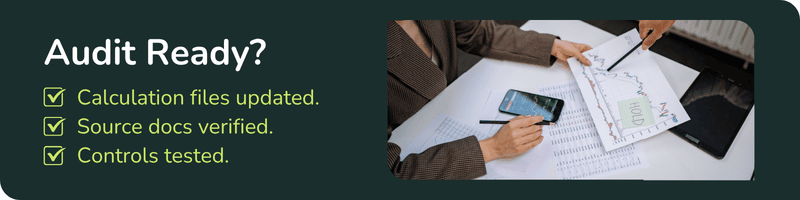
Carbon management services can help businesses prepare for assurance by building preparation for audits into emissions inventories by:
· Developing calculation files
· Maintaining source documentation
· Mapping data owners, and;
· Testing internal controls
This work may not always be visible in the final report, but it’s often what determines whether climate reporting can be delivered reliably.
Get proactive: Pre-empt and capitalise on disclosure requirements
Whether you are preparing for mandatory climate disclosure or are responding to customer requests, 4tomorrow can help you take the next step.
Get in touch with our carbon management team to learn how we can support your business.
Thanks for reading. The last post in this series will finish our analysis of current trends in sustainability reporting.
Harry
Carbon and Sustainability Consultant

References
[1] ASIC, “Sustainability reporting”, Australian Securities and Investments Commission.
https://asic.gov.au/regulatory-resources/sustainability-reporting/
[2] Australian Accounting Standards Board, “AASB S2 Climate-related Disclosures”, issued 20 September 2024.
https://standards.aasb.gov.au/aasb-s2-sep-2024
[3] ASIC, “ASIC issues early observations on sustainability reporting ahead of 30 June 2026”, published 18 May 2026.
https://asic.gov.au/about-asic/news-centre/news-items/asic-issues-early-observations-on-sustainability-reporting-ahead-of-30-june-2026/
[4] Auditing and Assurance Standards Board, “Sustainability Assurance”.
https://www.auasb.gov.au/implementation-support/sustainability-assurance/
Are you ready to unlock the potential of your emissions profile?
Contact 4tomorrow today and take your first step toward a sustainable future.