
Australia’s mandatory climate disclosure legislation is now in effect and links financial performance and environmental impact.
Historically, climate reporting was handled by in-house sustainability personnel (if at all), was often prepared annually and was primarily used for marketing purposes or securing investment. ASRS disclosure has changed this.
In-scope entities must now prepare annual sustainability reports accountable to company leadership. These reports must address climate-related risks and opportunities, governance, strategy, risk management, metrics and targets [1].
So what’s happened since the legislation came into effect?
A more structured and (hopefully) standardised approach to climate reporting!
Over the next decade, this is likely to influence far more than just the businesses covered by the legislation. As larger companies are directed to strengthen reporting processes, emissions data will increasingly flow through supply chains and will influence procurement decisions, lending conversations, tender requirements and board reporting.
What we see from the Group 1 reporters
ASIC has provided a useful snapshot of the project so far. The regulator reviewed a subset of the first reports prepared by Group 1 entities under Chapter 2M of the Corporations Act 2001, ahead of this year’s reporting season [3]. It’s nothing too ominous, and is broadly supportive of the tranche of submissions so far.
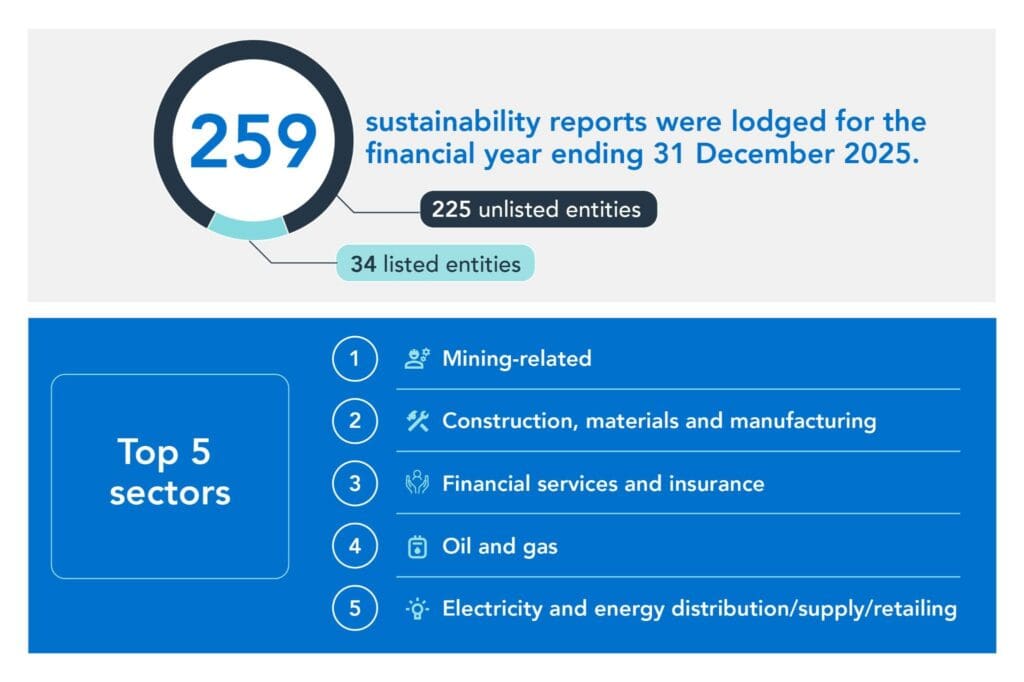
As of the 6th of May, 259 sustainability reports for the financial years ended on December 31 2025 had been lodged with ASIC.
34 were from listed entities, and 225 were from unlisted entities [3]. The reports were concentrated in several sectors, including mining-related businesses, construction, materials and manufacturing, financial services and insurance, oil and gas, and electricity and energy distribution, supply and retailing [3], reflecting the tendency of these sectors to be dominated by large corporations.
According to ASIC, the first reports showed an increase in both the quantity and quality of climate-related financial information. The standardised legislative requirements of AASB S2 helped to improve consistency and comparability [3]. Reports that used tables, diagrams and other visual aids were called out as useful for presenting complex information clearly to the regulator [3]. All the more reason to rely on a single source of truth for emissions reporting – God bless the humble dashboard.
ASIC also identified areas showing immature reporting practice. These include:
- Clarity of cross-references
- Treatment of voluntary disclosures
- Explanations of assumptions and measurement uncertainty
- Handling of climate-related risks
- The need to avoid disclaimers that could confuse users about statutory reporting obligations [3].
ASIC also emphasised that the purpose of sustainability reports is to provide decision-useful information which complies with the Corporations Act and AASB S2 [3].
Looking ahead to Group 2 and Group 3 entities with looming reporting periods, these observations make sense. It’s great that ASIC is proactively engaging with the public with feedback about sustainability reporting, and we look forward to that continuing.
It’s also important to note that ASIC’s observations are based on a desktop review of a sample of reports. The final observations from last FY’s reports should be published in the second half of this year, so stay tuned.
Our takeaway is that a report can only be as reliable as the data and processes behind it.
The macro: Australian businesses and sustainability reporting
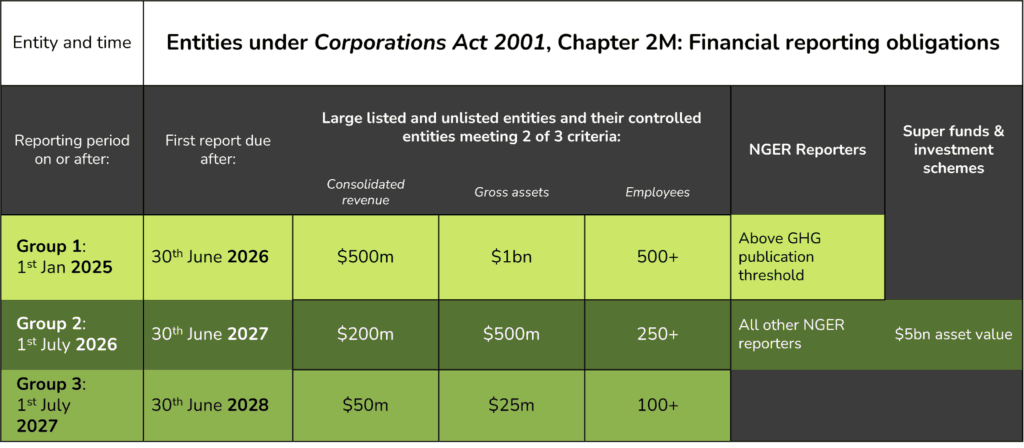
The above table shows the thresholds for reporting, based on company size. Triaging climate disclosure requirements like this creates three phases of motivation for businesses:
Compliance
Businesses need to understand whether they are captured, what they must disclose, and when reporting obligations apply. As we’ve seen, this has begun. Group 1 entities started reporting for financial years beginning on or after 1 January 2025 [2].
Control
Businesses need reliable emissions data, documented methodologies, internal review processes and assurance-ready evidence. The control approach is where many organisations discover gaps in systems, supplier data and operational records. Group 1 is here, and Group 2 is coming to grips with this.
Management
Once data quality increases, businesses use it to reliably reduce emissions, manage costs, respond to customers, confidently apply for tenders, inform capital decisions and prepare credible transition plans. The Group 1 scramble to deadline has ended, and they’re looking for a way to reduce their emissions. This is likely to come from value chain emissions reduction, where accurate supplier-specific emissions factors replace industry average factors, which are conservative and usually 40% higher.
The businesses that move quickly and efficiently through these phases treat emissions data as a decision-making asset.
How 4tomorrow can support the transition
You’ve read this far, thank you. Please indulge me a little longer.
4tomorrow’s carbon management platform converts your activity data into an emissions inventory, and from there, helps you convert evidence to action.
Carbon management supports emissions inventory development, Scope 3 assessment, methodology selection, assurance preparation and reporting inputs.
For businesses falling outside ASRS disclosure, carbon management prepares for the inevitable wave of customer data requests while improving your chances in tenders.
Whether they sell toasters or turbofans, all Australian businesses will face increasing expectations around climate transparency and emissions performance. These expectations can become a useful driver of better data, stronger decisions and more resilient business strategy.
ASRS starts at the top end, but pulls everyone into disclosure
Whether you’re preparing for mandatory climate disclosure or are responding to customer requests, 4tomorrow can help you take the next step.
Get in touch with our carbon management team to learn how we can support your business.
Thanks for reading. The next two posts in this series will look at trends we’ve noticed and where we think they’re heading.
Harry
Carbon and Sustainability Consultant

References
[1] ASIC, “Sustainability reporting”, Australian Securities and Investments Commission.
https://asic.gov.au/regulatory-resources/sustainability-reporting/
[2] Australian Accounting Standards Board, “AASB S2 Climate-related Disclosures”, issued 20 September 2024.
https://standards.aasb.gov.au/aasb-s2-sep-2024
[3] ASIC, “ASIC issues early observations on sustainability reporting ahead of 30 June 2026”, published 18 May 2026.